Most tree work at a landed house in Singapore is a cutting back job rather than a removal. Send a photo first. If the tree needs a site visit we arrange one within three working days, check whether it sits in a Tree Conservation Area, and send a written quote three working days after that.
- A photo starts it. Enough for an arborist to say what the tree needs.
- Access moves the price most. A narrow side gate changes a job more than the tree does.
- More is not better. Agree 25% off the crown and 25% is what it should get.
- The paperwork comes before the saw. Risk assessment and method statement first.
- We clear up. Cut material leaves with us on the day.
Most of the tree calls we get come from landed homes.
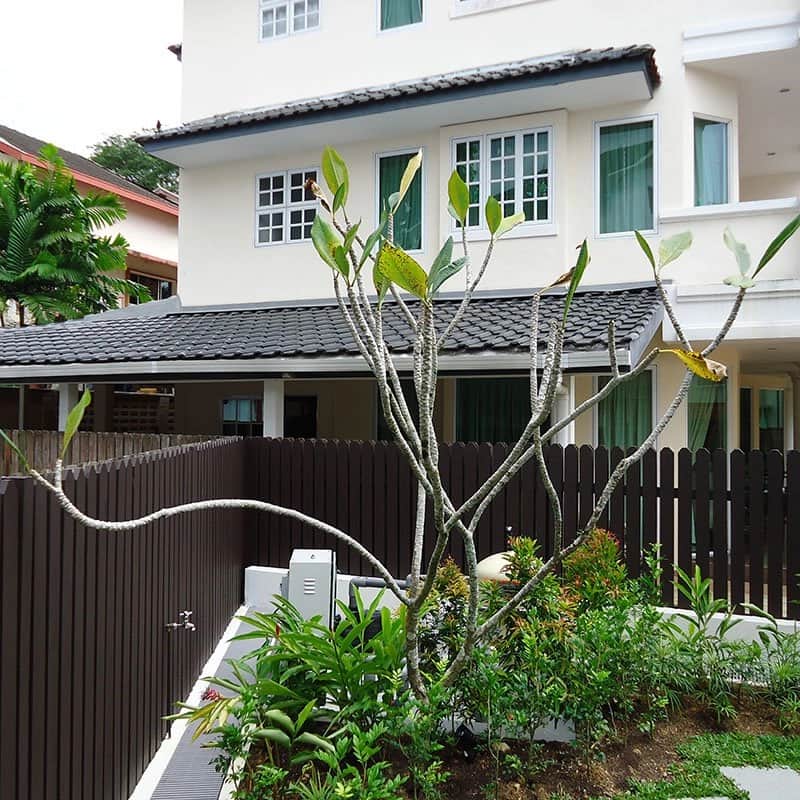
A frangipani that has grown over the porch. A rain tree dropping branches onto the car. A crown that gets closer to the neighbour's roof every year.
Almost nobody has bought tree work before, so the questions are always the same ones, asked in the same order.
Here they are, answered in that order.
Who do I call to cut a tree at my house?
Start with a photo. One picture on WhatsApp is usually enough for an arborist to tell you whether the tree needs cutting back or taking out, and it costs you nothing.
If the tree needs a proper look, we arrange a site meeting within three working days of your enquiry.
At that visit we confirm exactly where the tree stands and whether it sits inside a Tree Conservation Area.
You get a written quote within three working days after the visit.
When you confirm the quote, we give you the scheduled work date. Before anyone starts we send you the risk assessment, the method statement and the other documents the job needs. The invoice comes once the work is finished.
Does my tree need cutting down, or just cutting back?
Cutting back, nine times out of ten. A tree that looks frightening from the kitchen window is usually carrying a few dead limbs and a crown that has closed up, and both are pruning jobs.
Pruning is sold four ways. Standard pruning, crown cleaning, crown reduction and pollarding. The differences are covered in pollarding and crown reduction.
Removal is sold two ways. The tree cut flush to ground level with the rootball left in, or the rootball grubbed out as well.
One thing worth knowing before you agree a scope. More is not better. If the agreed job is to reduce a crown by 25%, that is what a tree should get. Owners often expect 40% or 50% once the crew is up there, and taking that much off a healthy tree does it harm rather than good.
Which one your tree needs comes down to the trunk and the base. The branches tell you much less.
What if the roots are lifting my driveway or getting into a drain?
Have the tree looked at before anyone cuts a root. Roots sit shallow and spread past the crown, so they lift pavers and thin concrete as they thicken. Cutting through them on one side can leave a tree that stands for a while and then fails in a storm.
Roots rarely break into a sound pipe. They get in where there is already a crack or a leak, so a drain that keeps blocking needs the pipe repaired as well as the roots cleared.
If the tree has to go because of its roots, ask for the rootball to be grubbed out. Cutting flush to the ground leaves the roots under the paving.
How does the equipment get into a landed driveway?
Access is usually the single biggest thing on the price, ahead of the height of the tree. It is the first factor we look at on site.
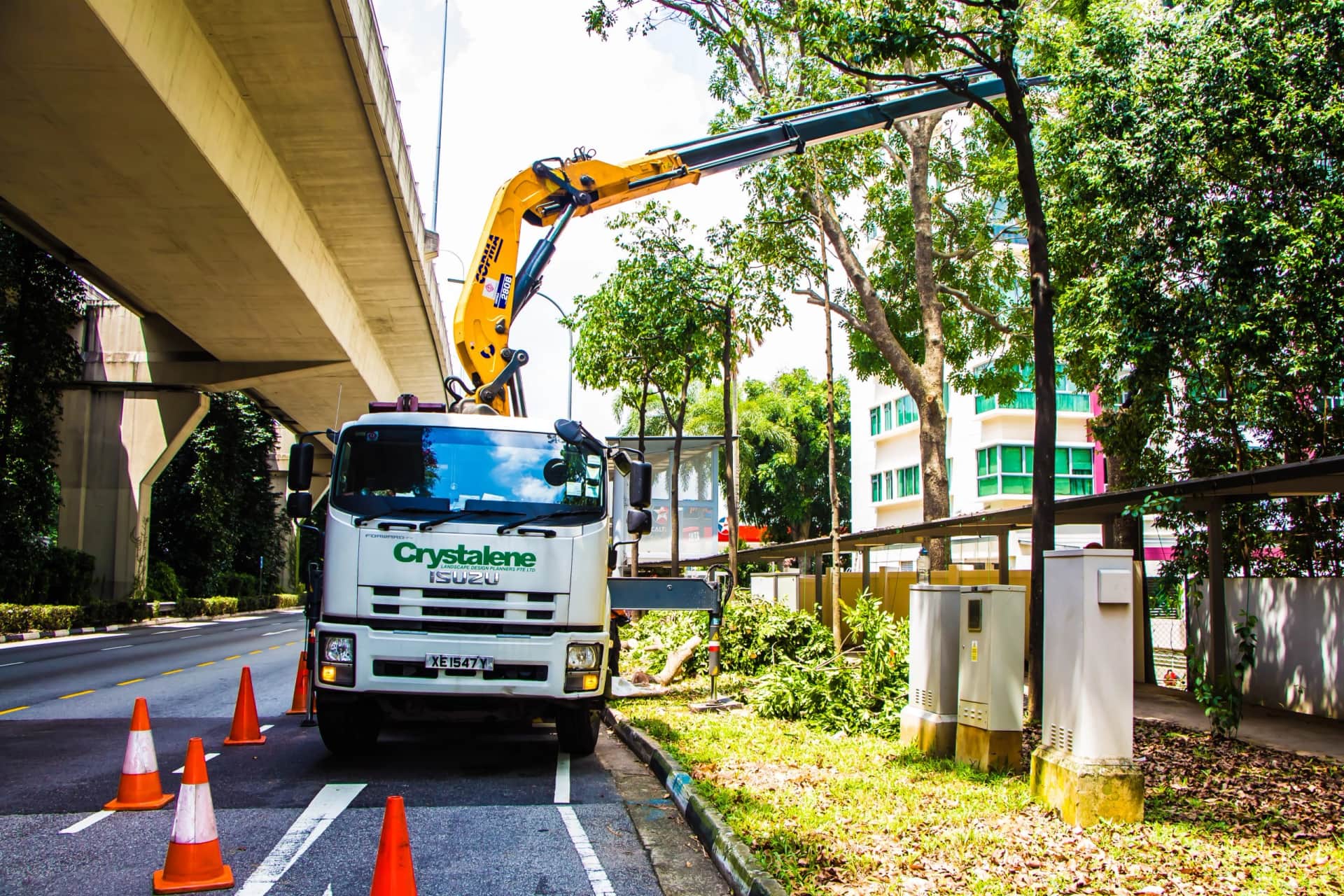
A tree a crane lorry can park beside is a straightforward job. The same tree in a back garden behind a side gate is a different job, because the crew has to climb it and lower every section by rope, and that takes longer and takes more people.
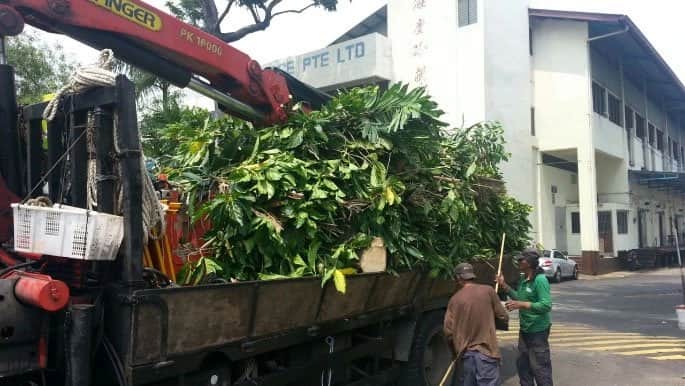
Depending on the site we may use a crane lorry, chainsaws, blowers, a stump grinder and other tree cutting equipment. What fits down your driveway decides a lot of that.
This is why nobody can price a garden tree over the phone, and it is the main reason two quotes for the same tree land far apart. There is more on that in what it costs to cut a tree in Singapore.
What happens to my garden on the day?
The area under the tree is closed off while anyone is cutting above it. Everything that comes out of a tree comes down through that space, so nothing else on the day matters more.
Before work starts we prepare and submit the risk assessment and the other safety documents, run a toolbox meeting and safety briefing with the crew, and put site protection measures in place for the people working, the people around and the property itself. Tools and machinery are inspected regularly.
What that looks like at your house depends on your house, so ask at the site visit. Where the lorry will stand, where cut material gets stacked, which hours suit you, and what goes down over the turf and the driveway.
Cut branches leave with us. Clearing away is part of the job and it should be written into the quote. You should not have to find that out later. If a stump is being ground out too, that gets priced as its own item.
What about the branches hanging over my neighbour?
Settle it with your neighbour before the work date. The day itself is too late.
A crew standing in your driveway with a saw running is the worst possible place to work out who agreed to what. Where a tree sits on a boundary, or a crown reaches across one, we ask that everyone with an interest in the tree has agreed the scope before we schedule the work.
We are contractors and not lawyers, so we do not advise on who owns which branch. What we do handle is the permission side of the tree itself. Whether the tree sits in a Tree Conservation Area is checked at the site visit, and where approval applies the necessary NParks approvals and permits are obtained before the works are carried out.
If you are unsure, say so at the site visit. It is a much cheaper conversation before the date than after it.
How often should the trees at my house be looked at?
Once a year for anything mature, and again after heavy weather. That is the honest answer for a landed garden, where there are usually only a handful of trees and one of them is doing all the growing. A yearly look at the trees you have costs very little next to the work it catches early.
Trees here grow all year, so a garden that was fine two monsoons ago may not be now. The signs a tree is due are worth learning, because you walk past them every day and we do not.
If something has already come down, that is a different call. For fallen or damaged trees blocking access we aim to be on site within two hours during office hours and within three hours outside them, and the first job is making the area safe and clearing the way. There is a short list of what to do in the first ten minutes, and how to get a crew out is a separate read.