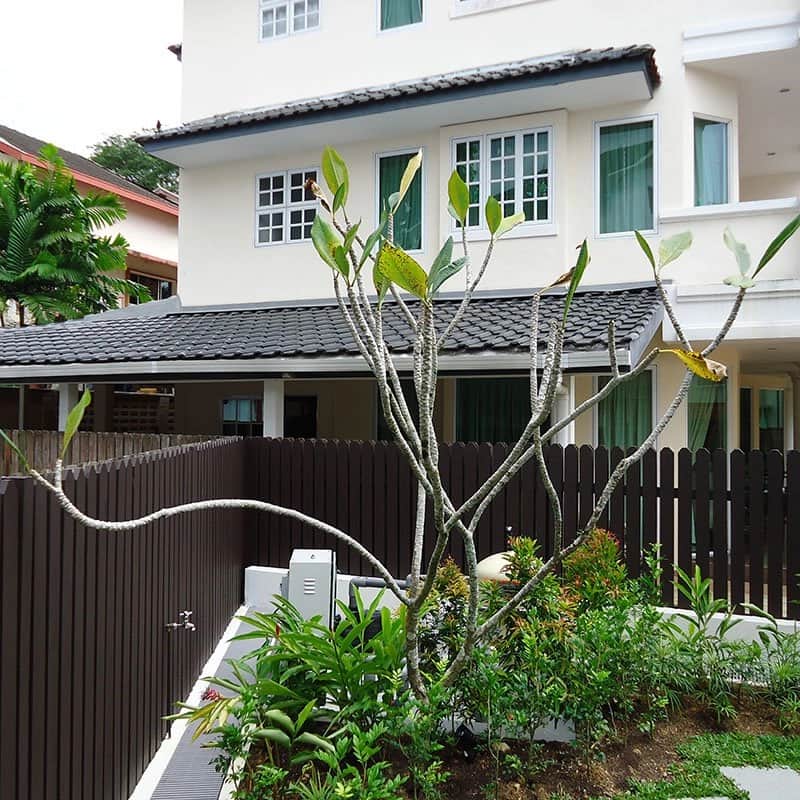
Singapore tree contractors publish rates from about S$200 for pruning a single tree up to S$5,000 and beyond for a large removal in a tight spot. Those are other companies' advertised ranges, and they are useful for one thing: telling you roughly what bracket you are in before you call anyone. Crystalene does not quote from a rate card. Every site is assessed individually before we give a price, and that assessment is free.
- The table below is the market's published rates, not ours. Crystalene prices every site individually.
- Size sets the bracket, access sets where you land in it.
- Two identical trees can be quoted very differently. It is usually about getting equipment in, not about the tree.
- Paperwork is part of the price. Risk assessments, method statements and any approval are quoted work, not free extras.
- Check the clearing is in the quote. A cheap number often leaves it out.
- A stump is a separate line. Grinding is roughly S$150 to S$500.
- Approvals are checked at the site visit, before a price is agreed.
- A photo is usually enough for a free quote without a site visit.
Cutting a tree back is not tidying. Done right it keeps a tree healthy and stops branches coming down in a storm. Here is what the price is made of.
How much does it cost to cut a tree in Singapore?
Nobody can tell you what your tree costs without seeing it. What we can tell you is the going rate, so you know whether a quotation is in the right neighbourhood.
These are the ranges other Singapore tree contractors publish on their own websites, gathered in September 2026. They are not our prices and they are not a quotation from anyone.
| Job | Advertised market range | What that usually covers |
|---|---|---|
| Pruning or crown reduction, per tree | S$200 – S$800 | Crown cleaning, thinning or cutting back |
| Small tree removal, under 5m | S$300 – S$600 | Cut flush to the ground, waste carted away |
| Medium tree removal, 5–10m | S$600 – S$1,500 | Climbed and sectioned, waste carted away |
| Large tree removal, 10–20m | S$1,500 – S$4,000 | Rigged down in sections, crane where needed |
| Complex removal, tight access | S$2,500 – S$5,000+ | Crane or boom lift, restricted site, traffic management |
| Stump grinding, per stump | S$150 – S$500 | Ground out below soil level |
Use it as a sanity check, not as a budget. Two things are worth knowing about a table like this before you lean on it.
The published ranges disagree with each other, sometimes by a lot. On pruning alone, one Singapore contractor advertises S$200 to S$600 a tree and another S$80 to S$3,000. That spread is not sloppiness. It is what happens when a single number has to cover a shrub by a fence and a mature rain tree over a driveway, and it is the clearest evidence there is that a rate card cannot price a tree.
And an advertised range tells you nothing about what is inside it. A low number with the clearing left out is not cheaper than a higher number with the waste carted away. It is a smaller quotation for less work.
Rootball removal sits outside the table entirely, because it depends on what you want to do with the ground afterwards. Leaving the stump in costs less. Grubbing the rootball out is a bigger job, and you only need it if you are building or planting where the tree stood.
What Crystalene does instead. We assess every site individually before quoting, which is the only honest way to price a tree. Send a photo and we will tell you what the job takes and what it costs. The quotation is free and you are not committed to anything.
A small garden tree a crew can work from the ground sits at the bottom of any range. It is a short job, the material is light, and one truck takes it away.
A tall tree over a driveway sits at the top. It has to be climbed or reached with a machine, every piece has to be lowered rather than dropped, and the crown fills more than one load.
What makes one tree cost more than another?
Six things. This is the list our own arborists quote from.
- Accessibility to the tree. Can a crew and their equipment reach it, and get the cut material back out again? A tree in an open garden is straightforward. A tree in a back courtyard, with everything carried out through the house, is not.
- Size and height. A tree that can be worked from the ground and a tree that has to be climbed are different jobs before anyone makes a cut.
- The type and scope of the work. Cutting a crown back by a quarter and taking the whole tree out are different prices, and so are two crown reductions of different depths. The scope is agreed before the work starts, not decided on the day.
- Complexity, and the equipment it calls for. Most trees are climbed. Some need a crane or a boom lift, usually because of what is underneath them rather than because of the tree itself.
- Documentation and administration. Risk assessments, method statements and any approval the tree needs are real work before anyone makes a cut, and they are part of the quotation.
- The site itself. Every site is assessed individually before we give a price. None of the above is applied off a rate card.
Access is the one that catches people out. Two identical trees in two gardens can be quoted very differently, and it is rarely about the tree. It is about whether a crew can get equipment to it and get the cut material back out again without going through somebody's living room.
When do they need a crane or a cherry picker?
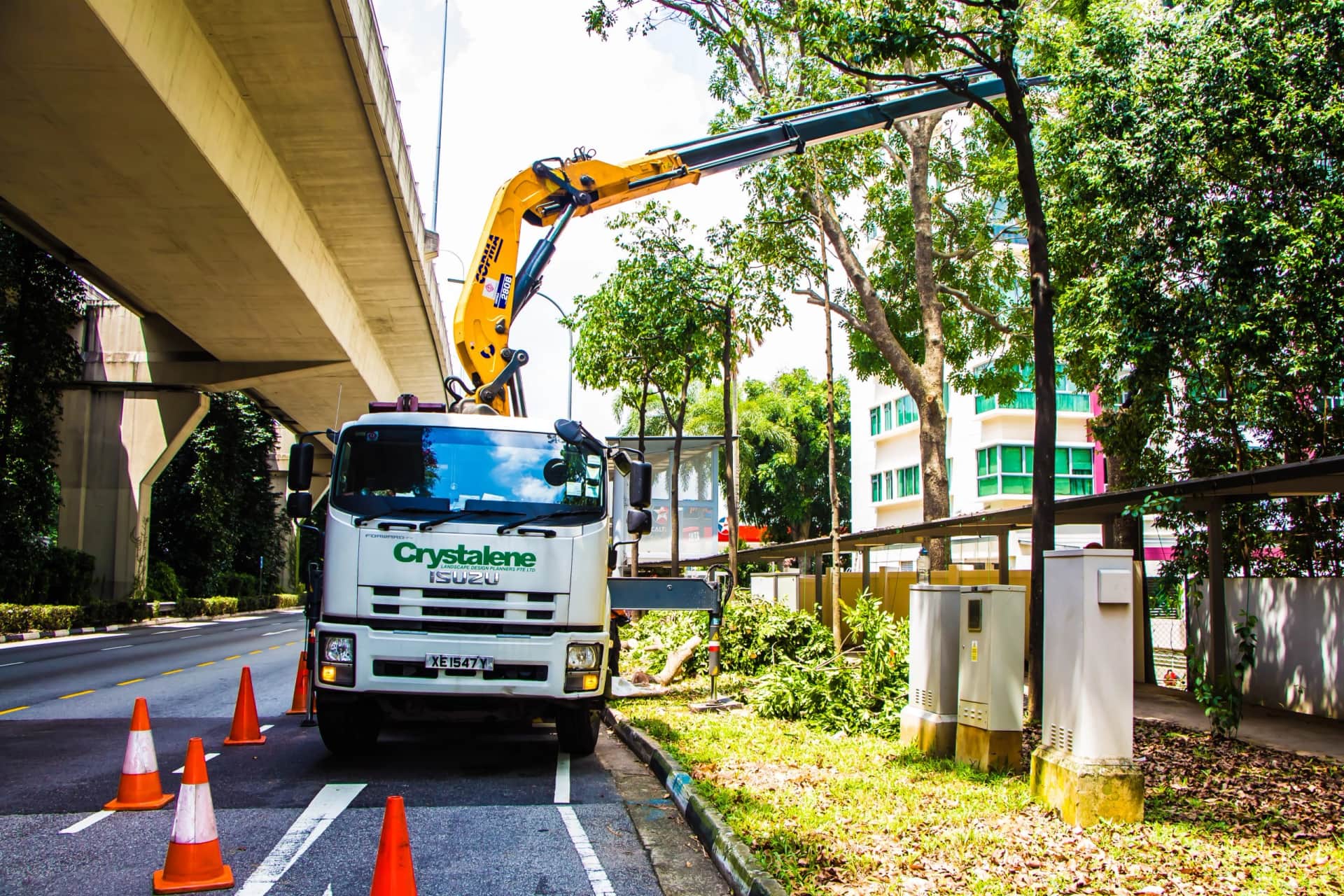
When the branches cannot be lowered safely on ropes, or when there is something underneath that cannot be risked. That is the single biggest step up in price on a tree job, and it is what moves a quote from the middle of the table to the bottom row.
Most trees are climbed and the cut sections are rigged down. That works when there is somewhere for the material to land. Bring in a carpark, a glass roof, a pool, a boundary wall or a service line, and every piece has to be held rather than dropped, which is where the machine earns its cost.
A crane also changes the site around the tree. It needs standing room, a route in, and often permission to sit where it sits. That is part of why a large tree in a tight condominium driveway is priced differently from the same tree on an open lawn. The same thing decides the price at a house, where a side gate can rule the machine out altogether. That is covered in tree cutting at a landed house.
Do I need NParks approval, and does it cost me?
Some trees need approval before they can be cut. It is worth knowing before you agree a price, rather than on the morning of the work.
You do not have to work out whether yours is one of them. Crystalene is an NParks approved contractor. At the site visit we confirm where the tree sits and whether it is inside a Tree Conservation Area, and where approvals or permits are needed, we obtain them before the works are carried out. You are not left to file anything yourself.
As for the cost, the work of getting an approval shows up inside the quote rather than as a separate bill. Documentation and administration are one of the six things we price on, and an approval can add lead time as well. Ask any contractor what it adds to the price and what it adds to the date, us included.
Send a photo and tell us where the tree is, and we will tell you what applies before you book anything.
Why is one quote half the price of the other?
Usually because the two prices cover different work. A big gap between two numbers has a boring explanation far more often than a sinister one.
Four things are worth checking on the low one.
- Clearing and disposal. If the price only covers cutting, the material stays where it falls and becomes your problem.
- Insurance and safety certification. Ask for it. Work at height over a building is not the place to find out it does not exist.
- Who is doing the cutting. Cutting done badly is not a neutral outcome. It leaves a tree that needs more work sooner. See pollarding and crown reduction.
- Approvals. Ask whether getting any approval the tree needs is in the price, and who is arranging it.
Crystalene is bizSAFE Level 3 certified, an NParks approved contractor, and our arborists are ISA-certified. Ask whoever you call the same things, us included. There is more on this in how to choose a tree cutting contractor.
Does the price include taking the branches away?
It should, and it is the item most often left out of a cheap quote. Confirm it in writing before the work is booked.
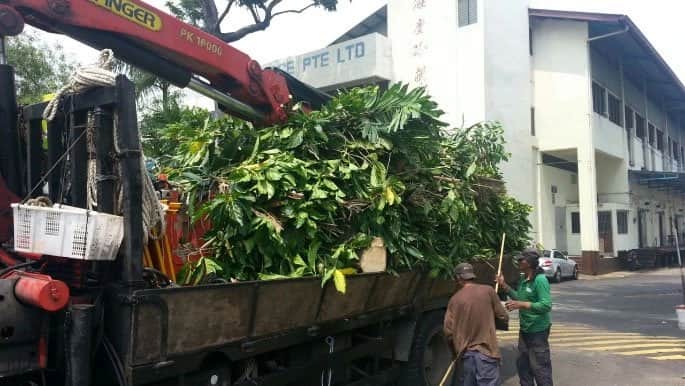
Cutting is only half of a tree job. A mature crown is a large volume of material once it is on the ground, and moving it takes labour, a vehicle and somewhere to take it. That is real cost, so a price that leaves it out looks better than a price that includes it while buying you less.
Ask two more things while you are at it. Whether the stump is being ground out or left in the ground, and what happens to the price if the crew arrive and find something different from the photos. We cover the stump question in what to do with the stump after a tree comes out.
How do I get a price without paying for a visit?
Send a photo on WhatsApp. Our quotes are free whether we price it from pictures or come out and look, so there is nothing to pay either way.
Three things make a photo useful. Get the whole tree in frame including the top. Include something for scale, a person or a car. And show what is underneath the branches, because that is what decides the method and the method is what sets the price.
Two pictures usually do it. One from far enough back to get the whole tree in, and one of the base of the trunk and what surrounds it.
If the answer depends on something a photograph cannot show, such as whether a machine can reach the tree, we come and look before quoting. That visit is still free, and it is the point at which an estimate becomes a price.
Would it be cheaper to just remove the tree?
Usually not. Tree removal is the bigger job, and most trees that look dangerous only need cutting back. We wrote about when a tree needs pruning and when it needs removing.
The whole tree has to come down in controlled sections, all of it has to be carted away, and the stump is still there afterwards. Then there is a gap in the garden that usually wants planting.
Waste is the part people underestimate. Cutting a tree back produces the branches you asked to lose. Taking it out produces the whole crown and the trunk as well, which is several times the volume going onto the truck.
Look at the table again and the arithmetic is plain. Cutting a sound tree back every few years costs less over the life of the tree than removing it once and rebuilding the bed around it. Removal is the right answer when the tree is unsound, not when the branches have got long.