Keep everyone away from the tree first, then call rather than message. Photograph the damage before anything is moved, and tell your insurer. A tree on a public road is reported to NParks. A tree inside your boundary is yours to arrange, and a fallen tree usually means the rest of it needs checking too.
- Clear the area first. People and cars away before anything else happens.
- Never touch a tree near wires. That is a power company job, not a tree job.
- Photograph before you clear. Insurers ask, and the pictures cannot be retaken.
- Public tree, public problem. Roadside trees are reported, not cut privately.
- Call, do not message, when something is blocking a road or resting on a car.
Storms here arrive fast and pass quickly, and the damage gets discovered in the few minutes afterwards when everyone goes outside to look. That is the moment this post is written for.
What should you do in the first ten minutes?
Keep people away from the tree and everything under it. Nothing else matters until that is done.
A tree that has already failed is not finished failing. Limbs left hanging in the crown come down later with no warning, and a trunk under tension can move when something near it is disturbed. The area under and around the tree is the dangerous part, not the piece lying on the ground.
Then work through this.
- Look up before you look down. Hanging branches are the thing that injures people after a storm, not the fallen trunk.
- Check for wires. If any part of the tree is touching or near a power line, stay back and treat it as live. That is a job for the power company first.
- Move cars if it is safe to do so. Only if nothing overhead has to be walked under to reach them.
- Do not start cutting. A chainsaw in a tangled, tensioned tree is how serious injuries happen, and a stormy afternoon is the worst possible time to learn that.
Who do you call, and in what order?
It depends on where the tree stands and what it has landed on.
- Anything involving power lines. The power company, before anyone else.
- A tree blocking a public road, or a roadside tree that has failed. Report it. Public trees are managed by the state and are not for a private contractor to touch.
- A tree inside your own boundary. Yours to arrange. Call a contractor rather than message one if anything is unsafe right now.
- A tree on a neighbour's land that has fallen onto yours. Speak to the neighbour, because the tree is still theirs even where it is lying.
If you are on the phone to a contractor, lead with three facts. Whether anyone is at risk, whether it is blocking access, and whether wires are involved. Those three decide how the job gets scheduled.
How fast can someone actually get here?
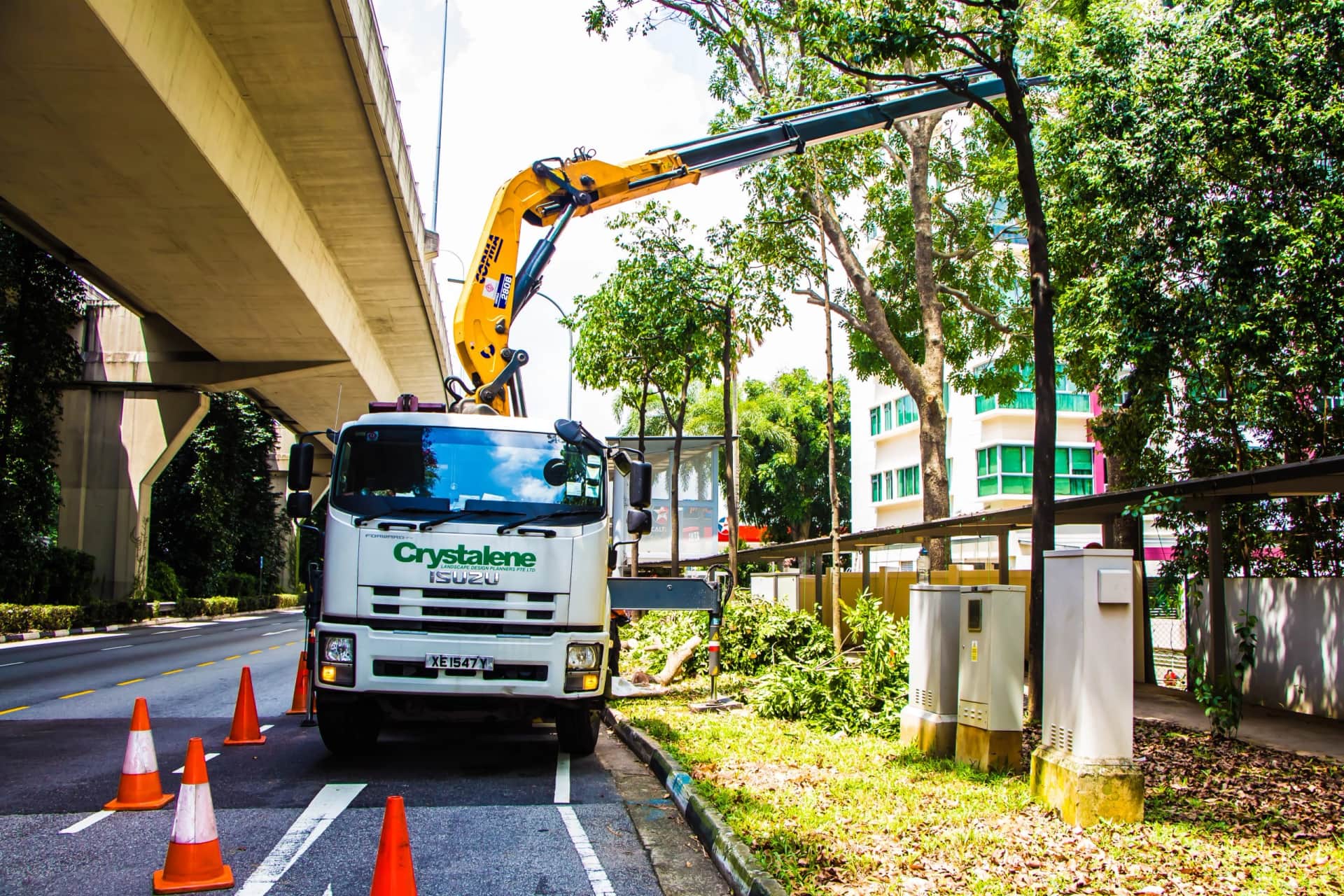
For a tree blocking a road or an access way, Crystalene aims to be on site within two hours during office hours, and within three hours after them.
Getting there is not the same as finishing. The first job is to make the area safe and clear whatever is blocking the way. How that call runs, and what to have ready when you make it, is in emergency tree removal after a storm. Taking the rest of the tree down, grinding the stump and tidying the site are scheduled after the danger is gone, usually as ordinary daytime work.
Two things are worth doing when you ring anybody, us included. Say in the first sentence whether something is blocking a road or an access way, because that is what moves a job to the front of the queue rather than into next week. And ask what it costs just to come out before a crew is sent. Coming out at night to a fallen tree is a different thing from a free visit to price a job, and it is easier to ask than to find out on the invoice.
What should you photograph before clearing up?
Everything, from far enough back to show what happened, and before anything is moved. This is the step people skip and regret.
Take these.
- The whole scene from a distance, showing the tree and what it hit.
- The base of the trunk and the root plate, including any lifted soil.
- Close-ups of the damage to property, from more than one angle.
- Anything still hanging in the crown.
Insurers ask for pictures of the situation as it was found. Once a crew has cleared the site, that evidence is gone and it cannot be recreated. Five minutes with a phone is worth more than any argument afterwards.
Tell your insurer early, before the clearing work is booked. Some policies have conditions about what has to happen first, and it is easier to ask than to find out later.
Why did the tree fail?
Almost always something that was already wrong, revealed by weather rather than caused by it. Healthy, sound trees survive Singapore storms routinely.
The usual causes are the ones an inspection would have found. Decay at the base or in the trunk. Roots cut through by works nearby, or a root plate sitting under paving. A crown grown dense and heavy enough to catch wind like a sail. A tight fork between two big limbs with bark trapped inside it.
This matters for a practical reason rather than a philosophical one. If one tree failed for a reason that applies across a site, the others are worth looking at before the next storm, not after it. On a condominium or a school ground that is usually the more important conversation than the tree already on the floor.
What happens when a crew arrives?
The site is made safe before any clearing starts. That means the hanging material comes out of the crown first, which is the opposite of what most people expect, because the instinct is to move the piece blocking the driveway.
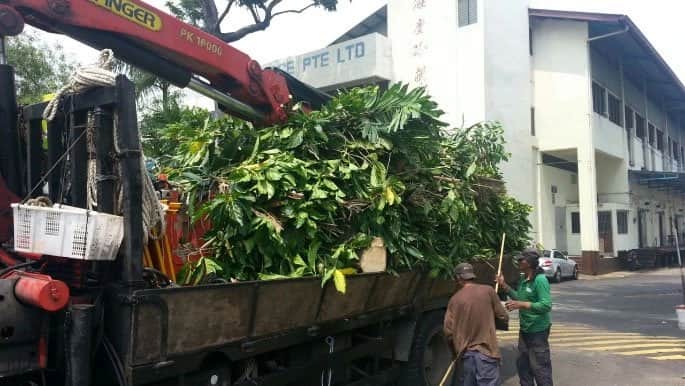
After that the work is straightforward. The tree is taken down in controlled sections, the material is cut up and carted away, and what is left of the tree is assessed. Sometimes a tree that has lost a limb is still sound and worth keeping. Sometimes the failure has exposed decay that settles the question.
Ask before the crew leaves whether the stump is being ground out, and whether anything else on the site now needs attention.
Should the rest of the trees be checked?
Yes, and it is the cheapest thing you will do all week. A storm is a load test that every tree on the site has just been through.
The ones worth looking at closely are any that have a new lean, cracked or lifted soil around the base, fresh splits at a fork, or hanging material still caught in the crown. Those are not seasonal problems. They are a tree telling you something has changed.
Crystalene runs scheduled tree inspections for condominiums, schools and commercial grounds, and after heavy weather that is usually the call that costs least and saves most.