The most common mistake is cutting a tree back hard and expecting it to stay small. It grows back faster and weaker. It is also the thing customers ask us for most often, usually as a quote for a 25% crown reduction and a request on the day for 40 or 50. The rest are ignoring the base of the tree, cutting roots for paving, and calling someone only after a branch has come down.
- Hard cutting makes trees grow faster. The tree replaces what it lost.
- More is not better. A 25% reduction is a decision, not a starting price.
- A green crown proves nothing. Decay starts at the base and roots.
- Roots are structure. Cutting them for paving destabilises the tree.
- Do not pile soil against a trunk. It rots what holds the tree up.
- The cheapest visit is the early one. Before anything has fallen.
Most tree problems we get called to were made by someone trying to help. The work was well meant, it was done by someone who cuts trees for a living, and it made the tree worse.
Here are the ones we see over and over.
Cutting a tree back hard to stop it growing
This is the big one, and it does the opposite of what people expect. A tree cut back hard grows back faster, not slower.
Leaves are how a tree feeds itself. Take most of them off in one go and the tree responds to the emergency by pushing out as much new growth as it can, as quickly as it can. Within a couple of years there is more growth than before, and it is worse growth. The new shoots attach at the surface of the old cut rather than deep in the wood, so they are weakly held and they get heavier every year.
Meanwhile the large flat cuts left behind are wounds the tree cannot close, and decay gets in through them.
The version done properly is crown reduction, where each cut goes back to a smaller branch that is already growing. The tree keeps its shape, keeps its structure, and does not panic.
Asking for more to come off than the quote says
The argument we have most often on a live job is about how much comes off, and it goes the same way nearly every time.
The quotation says the crown comes down by 25%. The crew is up in the tree, the work looks smaller from the ground than it did on paper, and the request comes to take 40% or 50% instead while everyone is already there and the machine is already paid for.
We do not do it, and the reason is the section above. That percentage was chosen for that tree. Doubling it turns a reduction into the hard cut that grows back faster, weaker and more expensive, and the person who asked for it is the person who pays for the regrowth in two years.
If you genuinely want more off, have it looked at again and re-quoted. What you should not want is a contractor who says yes to it from the ground, because that tells you exactly how they will treat your tree when you are not watching.
Judging a tree by how green it looks
A full green crown tells you the tree was healthy last season. It does not tell you the tree is safe now.
Trees fail at the base and in the trunk far more often than they fail in the canopy, and the crown can look untouched while that is happening. Bracket fungus growing out of the root flare, soft wood you can push a screwdriver into, a hollow at the base, or soil lifted on one side of a leaning tree are all serious. None of them shows up in the leaves.
This is why an arborist looks at the bottom of a tree first and the top second, which is the reverse of how everyone else looks at trees.
Cutting roots to make room for paving
A tree's roots are structure, not just plumbing. Cut through them on one side and you have removed part of what holds it upright.
We see this most often where a driveway is widened, a car park is extended or a path is laid closer to a tree than it used to be. The tree looks fine for a season or two. Then it comes down in weather it would previously have handled, and the failure is on the side where the roots were cut.
If works are happening near a mature tree, get the tree looked at before the digger arrives, not afterwards. There are usually ways to build around a root zone, and all of them are cheaper than losing the tree.
Piling soil or mulch against the trunk
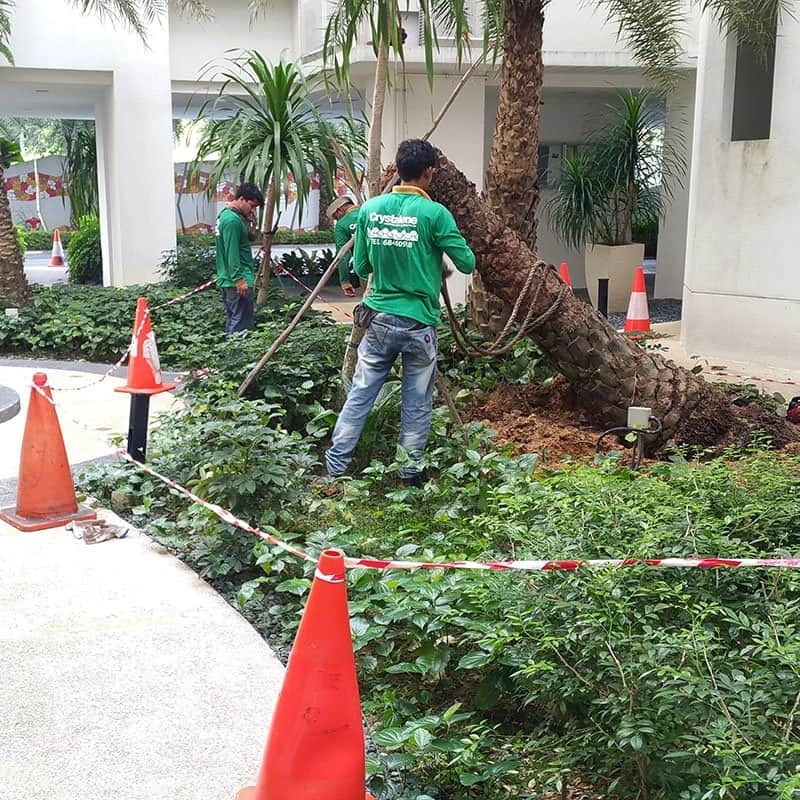
Mulch is good for trees. Mulch heaped against the trunk is not.
The base of a trunk is meant to be exposed to air. Bury it under soil or a cone of mulch and it stays damp, and wood that stays damp rots. What rots is the exact part of the tree carrying all the load.
It is one of the easiest things on this list to fix. Pull the mulch back so there is a gap around the trunk and you can see the flare where it widens into the roots. If you cannot see that flare, something is buried that should not be.
Waiting until something has already fallen
The most expensive way to buy tree work is on a Saturday with a car underneath.
Trees rarely fail without warning. Deadwood accumulates, a crown thickens up, a lean appears, a split opens at a fork. All of it is visible months ahead to someone looking, and all of it is cheaper to deal with then.
Called early, most of these are a short job on a working day. Called late, the same tree is an emergency, plus a claim, plus whatever it landed on. See what to do when a tree comes down in a storm for the situation nobody wants to be in.
Planting the wrong tree in the wrong place
The mistake gets made once and paid for annually.
A tree chosen for how it looks at nursery size, planted under a service line or three metres from a building, becomes a permanent maintenance cost. It has to be cut back forever to stay where it is, and cutting it back forever is how trees end up pollarded by default rather than by choice.
The fix is boring and it works. Ask how big the tree gets, and check what is above and below the spot before it goes in.
Assuming every leaning tree is dangerous
The one on this list that costs people money in the other direction. Plenty of healthy trees lean, and taking them down is a waste.
A tree that has leaned for years, with straight growth coming off the lean and undisturbed soil around the base, has usually grown that way and is stable. The one to worry about is a lean that is new, particularly with cracked or lifted soil on the opposite side. That is a root plate moving, and it is urgent.
Same shape, completely different answers. It takes someone looking at the base to tell them apart.