Book the tree clearing as its own job, before demolition or piling starts. The tree contractor checks whether the site sits in a Tree Conservation Area, arranges any NParks approvals the work needs, and takes each tree out with or without its rootball depending on what will be built over it.
- The trees set the first date. Any approval has to be in place before the first cut.
- Decide which trees stay before the plan is fixed. A tree you keep needs fencing before any machine arrives.
- Roots under a footing get dug out. Grubbing up the rootball clears ground that will be built on.
- The paperwork comes before the saw. You receive the risk assessment and method statement before work starts.
- Access moves the price. How a crane lorry reaches each tree matters as much as the tree.
This post is for developers, main contractors and owners rebuilding a landed house who have trees on the plot. It covers when the trees should come out, which ones can stay, and what happens to the roots.
When should the trees come out in a building project?
Plan the tree work at the very start, before demolition or piling.
Where NParks approval applies, it has to be in place before anyone cuts. So the trees can set the earliest date the rest of the site can move. Finding that out in week one costs nothing. Finding it out when the piling rig is booked costs days.
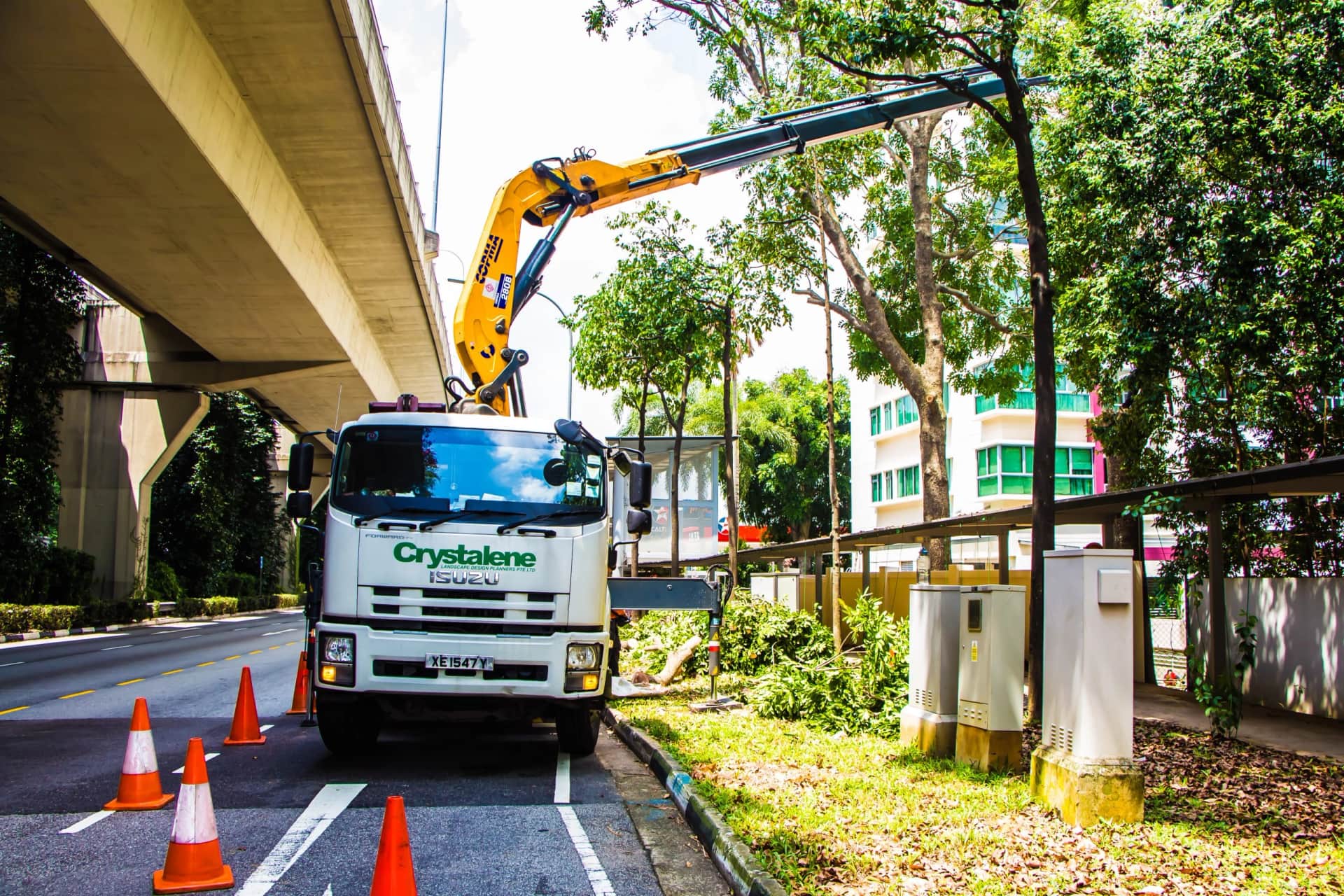
Early is also cheaper. Today a crane lorry can drive up to the tree. Once hoarding, site cabins and material stacks are up, the same tree may need a bigger crane or climbing work to reach.
At the site visit we confirm where each tree stands and whether the site sits inside a Tree Conservation Area. Once you confirm the quotation, you get a scheduled work date to build the programme around.
Call us at least a month before demolition is due to start. That leaves time for the site visit, the quotation and any approval the trees need.
Who should clear the trees, the tree contractor or the demolition contractor?
Either can hold the contract. What matters is who actually does the felling, the trade word for cutting a whole tree down.
Many demolition and main contractors pass the tree work to a specialist. Ask who will be cutting, and ask to see their certifications. Felling a large tree next to a live site needs people certified for chainsaw work, tree climbing, work at height and crane operation. It also needs someone who knows whether the tree needs approval first.
Developers are among our regular customers, alongside condominiums, landed homes and commercial buildings. Our arborists are ISA-certified, and our workers hold the chainsaw, climbing, work at height and crane certifications the job calls for.
If you are comparing contractors, our guide to choosing a tree contractor lists the six questions to ask.
We work for developers directly and as a subcontractor to the main contractor. Either way, Crystalene is answerable for the tree work.
Can some trees stay, and how are they protected?
Often, yes. A healthy mature tree that sits clear of the building footprint can usually be kept, and it will look better on handover day than anything newly planted.
Ask an arborist to look before the layout is fixed. A tree is only worth keeping if it is healthy enough to live through the work next to it. Our post on when a tree needs removing covers the signs.
A tree that stays needs fencing before any machine arrives. Its roots spread at least as wide as its branches and most of them sit close to the surface. Inside the fence there should be no parking, no stacked materials, no site cabin and no change in the ground level.
Keep the fence up until the landscaping is done. Branches in the way of a crane or scaffold should be cut back properly by a tree contractor before work starts. An excavator arm tearing them off leaves wounds the tree may not recover from.
What happens to the roots under the new foundations?
There are two ways to take a tree out, and the choice depends on what goes over the spot.
Cut flush with the ground. The trunk comes down to ground level and the rootball stays where it is. That is fine where only turf or planting will go. The stump can be ground down below the surface later, which our post on getting rid of a tree stump explains.
Grubbing up the rootball. The root mass is dug out of the ground as well. That is the right choice under a footing, a slab, a driveway or a drain line. A rootball left in place rots slowly, leaves a soft pocket in the ground and gets in the way of excavation.
Decide this tree by tree before the quotation, because it changes the equipment and the price. A grubbing job may need a stump grinder or an excavator as well as the crane lorry and chainsaws.
What has to be in place before cutting starts?
Four things, in this order.
- A site visit. We confirm where each tree is and whether the site sits in a Tree Conservation Area.
- Approvals. Where applicable, the necessary NParks approvals and permits are obtained before the works.
- The documents. We submit the risk assessment, the method statement and the other documents the job needs to you before work begins, so they can go into the site safety file.
- The briefing. On the day, the work team holds a toolbox meeting and safety briefing, the tools and machines are checked, and the area is protected so workers, the public and neighbouring property are kept safe.
The invoice follows once the work is finished.
What changes the price of clearing a site?
The quotation depends on six things.
- How easily we can reach each tree.
- The size and height of each tree.
- What is wanted, whether that is cutting flush or grubbing up the rootball.
- How complex the work is and what equipment it needs.
- The documentation and administrative work involved.
- The site itself. Every site is assessed before we give a price.
Access usually matters most. An open plot with lorry access throughout prices very differently from the same trees behind a standing house.
For a feel of single-tree costs, our post on what tree cutting costs in Singapore gives indicative ranges. A whole site is always priced from a visit.