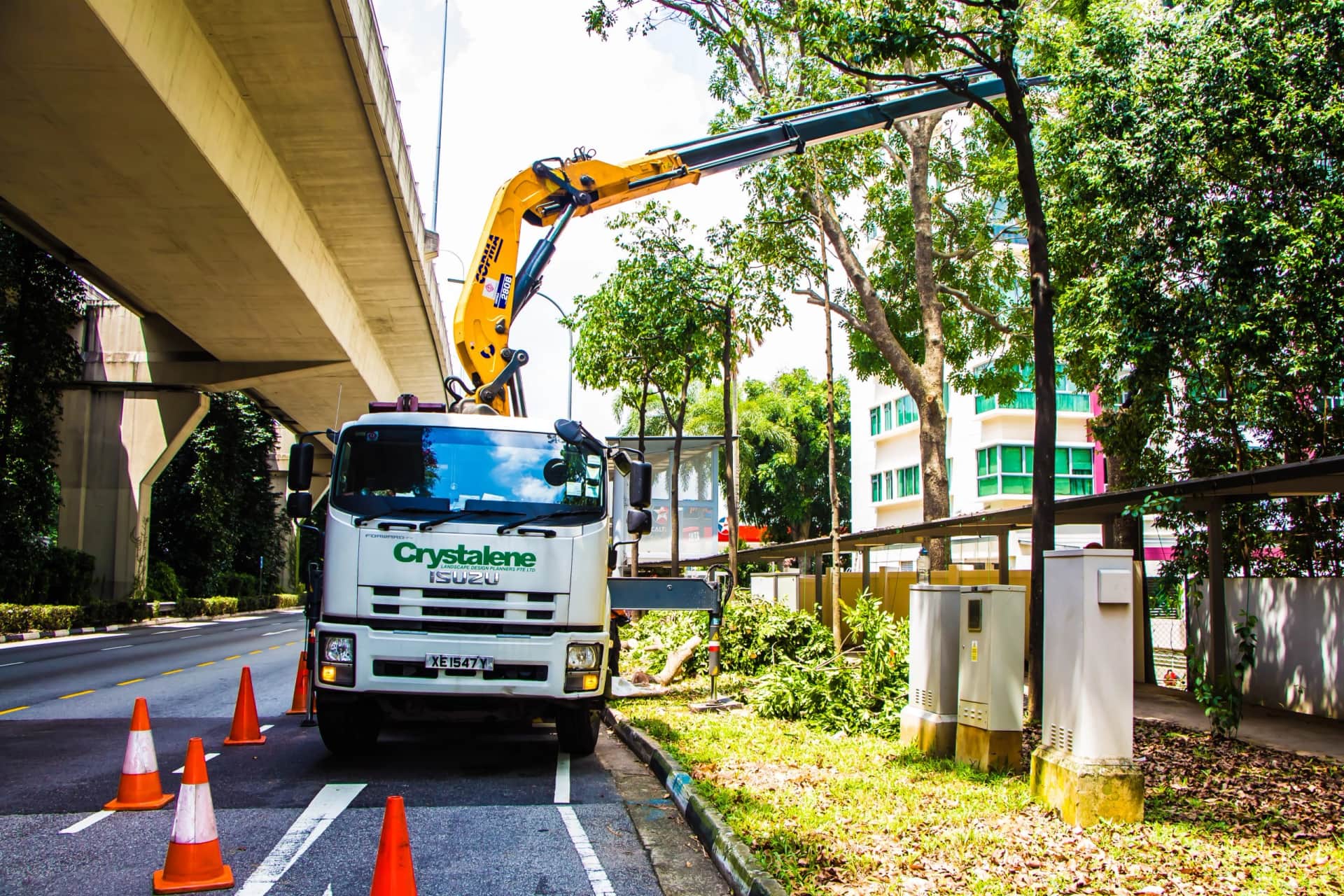
For a fallen or damaged tree blocking a road or a driveway in Singapore, Crystalene aims to be on site within two hours during office hours and within three hours after them. The first job is making the area safe and clearing the way. The rest of the tree is dealt with afterwards.
- Call, do not message. Anything unsafe right now needs a voice on the line.
- Lead with three facts. Anyone at risk, anything blocked, any wires.
- Getting there is not finishing. We make it safe first. Clearing comes after.
- Wires are never a tree job. The power company goes first, every time.
- Ask what it costs to come out before a crew is sent. Ask us too.
Storms here arrive fast and pass quickly.
Ten minutes later there is a limb across the driveway, or a whole tree on the fence, and nobody knows who to ring.
This post is about getting a crew to you.
If you have just walked outside and nothing has been made safe yet, start with what to do in the first ten minutes and come back to this.
Who removes a fallen tree in Singapore?
It depends on whose land the tree stands on, and that is settled before anyone picks up a saw.
- Inside your own boundary. Yours to arrange. Call a tree contractor directly.
- A roadside tree, or one on public land. Report it. Public trees are managed by the state and are not for a private contractor to touch.
- On a condominium's common property. The MCST or the managing agent gives the go-ahead. A single resident cannot.
- A neighbour's tree that has fallen onto your land. Speak to the neighbour. The tree is still theirs where it is lying.
- Anything touching or near a power line. The power company, before anyone else, and nobody goes near it until they say so.
Getting this right first saves a wasted callout. A crew cannot start cutting on land the person calling does not control.
How quickly can a crew actually get here?
For a fallen or damaged tree blocking a road or a driveway, we aim to be there within two hours during office hours and within three hours after them.
Getting there is not the same as finishing.
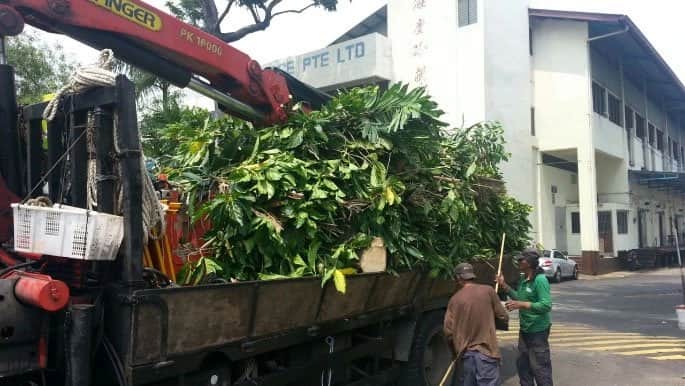
The first job is to make the area safe and clear whatever is in the way, so people and cars can move again. Taking down what is left of the tree, grinding the stump and tidying the site are scheduled after the danger is gone, usually as ordinary daytime work.
It is worth knowing why the split matters. A storm job is dealt with in two halves because the second half cannot be quoted properly in the dark with half the tree still hanging.
Is it an emergency, or can it wait until tomorrow?
Tell us what the tree is resting on and we will tell you on the call. You do not have to work it out yourself.
What moves a job to the front of the queue.
- A tree or limb blocking a road, a driveway or the only way in.
- Anything resting on a car, a roof, a fence or a wall.
- Material still hanging in the crown above somewhere people walk.
- A trunk that has split, or soil lifted around the base of a standing tree.
What can usually wait for a normal booking.
- A branch down on a lawn with nothing under it.
- A tree that has lost leaves or small wood but is otherwise standing.
- The stump, the ruts and the tidying after a clearance.
If you are not sure, say what happened and what is underneath it. That is enough for an arborist to judge it.
What should I tell you when I call?
Three facts first. Whether anyone is at risk, whether anything is blocked, and whether wires are involved. Those three decide how the job is scheduled.
Then the practical ones.
- Where you are, and the nearest gate or entrance a lorry can use.
- What the tree is on, and roughly how big it is.
- Whether a lorry can get in, or whether there is a narrow side gate. Access changes the method more than the tree does.
- A photo, if it is safe to take one. From far enough back to show the whole scene.
Photographs matter for a second reason. Take them before anything is moved, because your insurer will ask and the scene cannot be recreated once a crew has cleared it.
What does emergency tree removal cost?
There is no flat rate for it, and anyone quoting one over the phone has not seen what they are pricing.
A storm job is priced on the same things as any other. How easy the tree is to reach, how big and how tall it is, how much work it needs, how difficult the job is, what machines it takes, and the paperwork the site needs. The full picture is in what it costs to cut a tree in Singapore.
Two things are worth asking before a crew is sent. Ask us the same as anyone else. What it costs just to come out, and whether taking the wood away is included in the price you are given.
Coming out at night to a fallen tree is a different thing from a free visit to price a job. It is easier to ask than to find out on the invoice.
What happens once the tree is cleared?
The site is made safe, the material is carted away, and what is left of the tree gets assessed properly in daylight.
Sometimes a tree that has lost a limb is sound and worth keeping. Sometimes the failure has exposed decay that settles the question. That decision is easier after the mess is gone than during it.
Two things to sort before the crew leaves. Whether the stump is being ground out or left, and whether anything else on the site now needs attention.
The second one is the important one. A storm is a load test that every tree on the site has just been through, so the trees still standing are worth a look while somebody qualified is already there. What made the first one fail is usually not unique to that tree.